
African Languages Lab has launched Mansa, a multilingual and multimodal AI platform designed to bring African languages further into the digital economy.
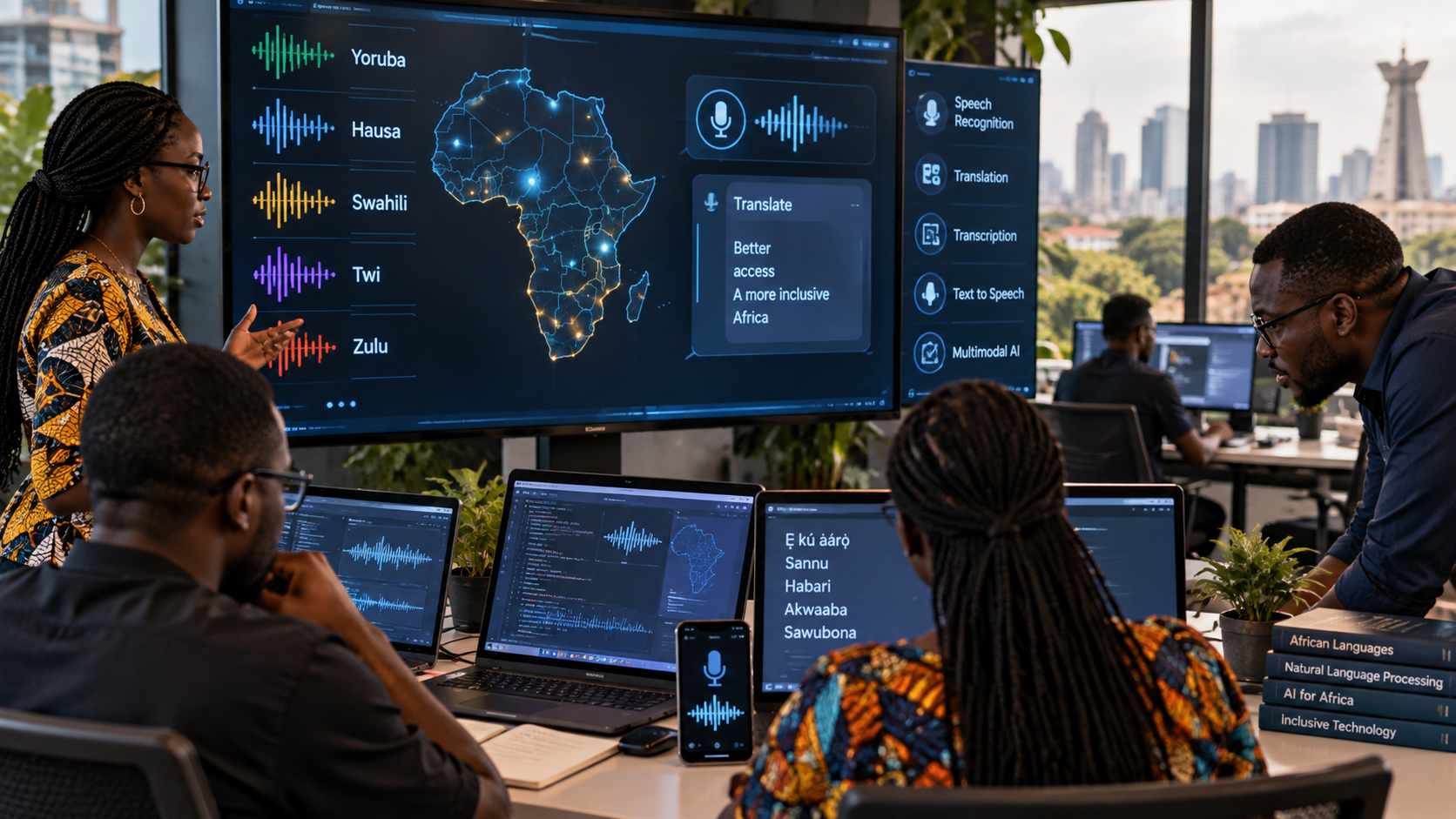
The platform currently puts more than 30 African languages into production, supporting applications including translation, transcription, speech processing and multimodal AI. The company says Mansa is designed for enterprise and developer use rather than simply as another consumer chatbot.
The launch highlights a problem that has been largely overlooked in the global AI race: the technology may be advancing rapidly, but many of the world’s languages still lack the data needed to make modern AI systems work well.
The data problem behind African-language AI
African languages account for a significant share of the world’s linguistic diversity, yet many remain poorly represented in digital datasets used to train artificial intelligence systems.
African Languages Lab has spent years addressing that problem by collecting and curating language data. The company says its broader collection covers more than 70 African languages, although it currently limits Mansa’s production deployment to languages where it believes the available data and model performance are sufficiently strong.
That distinction is important.
Having data for a language does not automatically mean an AI system can understand it reliably. African languages often contain complex morphology, tonal variation, dialect differences and cultural context that can make translation and speech recognition more difficult.
Mansa is being developed around those challenges rather than treating African languages as a simple extension of English-language AI.
Building on existing AI rather than starting from scratch
One of the more interesting aspects of Mansa is what African Languages Lab did not do.
The company did not attempt to build a frontier AI foundation model from scratch.
Instead, it adapted an existing foundation model and focused its effort on African-language data, model fine-tuning and evaluation.
That approach reflects a potentially important strategy for African AI development.
Building a model at the scale of the world’s largest AI systems requires enormous amounts of computing power, capital and infrastructure. African companies may be able to create more immediate value by adapting existing technology to problems that global AI companies have not adequately solved.
Mansa is an example of that approach: build the language and data layer that is missing, then use it to create applications and services for African markets.
Research suggests data may matter more than model size
The technology behind Mansa is also part of a broader body of research from African Languages Lab.
A paper presented at the 2026 Annual Meeting of the Association for Computational Linguistics describes a dataset covering 40 African languages, containing 19 billion text tokens and more than 12,600 hours of aligned speech data.
The researchers found that fine-tuning relatively modest models on targeted African-language data produced substantial improvements. In tests involving 31 languages, the approach produced significant gains across several translation benchmarks.
The researchers also found that a 1-billion-parameter model matched or surpassed Google Translate in some languages, including Yoruba and Twi. Their conclusion points to a critical lesson for African AI: data scarcity can be a bigger constraint than model size.
From translation to a wider AI infrastructure layer
Mansa is being positioned as more than a translation tool.
African Languages Lab says the platform can support text and voice interactions, translation, transcription, text-to-speech and multimodal applications. Its technology is also being developed for sectors including healthcare, education, commerce and financial services.
That could make African-language AI particularly important in markets where English, French and other colonial languages do not reflect how many people communicate in everyday life.
A farmer interacting with an agricultural service, a patient communicating with a healthcare provider, or a customer using a financial service may be far more comfortable using a local language than English or French.
AI that can understand those languages therefore has the potential to expand access to digital services rather than simply make existing applications more sophisticated.
The bigger opportunity for Africa
The Mansa launch also reinforces a broader point about Africa’s position in the global AI economy.
Africa does not necessarily need to compete with the world’s largest technology companies by building another frontier chatbot.
It can create value by solving problems those companies have historically overlooked.
Language is one of them.
The continent’s linguistic diversity creates a huge technical challenge, but it also represents a potentially valuable layer of digital infrastructure.
If African companies can build reliable datasets, language models, speech systems and developer tools around those languages, they can provide the foundation for a new generation of locally relevant AI applications.
That could eventually extend well beyond translation.
The bigger prize is an AI ecosystem that can understand Africa on Africa’s terms.
Why this matters
Mansa’s significance is therefore not simply that an AI platform now supports more than 30 African languages.
It demonstrates a different way of thinking about Africa’s role in artificial intelligence.
Instead of trying to win the global AI race by copying what the biggest technology companies are already doing, African technology companies can focus on the data, languages, infrastructure and applications that are uniquely important to the continent.
The companies that build those layers may ultimately become just as important to Africa’s AI economy as the companies building the models themselves.
Sources: African Languages Lab; Association for Computational Linguistics (ACL 2026).