
Kenya’s electric-mobility company is expanding its battery-swapping network across Africa as investors back infrastructure designed to make electric motorcycles commercially viable.
Kenyan electric-mobility company ARC Ride has secured $33.3 million in new financing to expand its battery-swapping infrastructure and electric motorcycle operations across Africa.
The financing combines a $23 million Series A equity round with $10 million in debt. The equity round was led by Novastar Ventures and Norrsken22, with the International Finance Corporation (IFC), British International Investment (BII) and Proparco participating. Existing investors Musashi Seimitsu Industry and Talanton are also putting additional capital into the business.
The funding comes as electric motorcycles gain momentum across African markets, but infrastructure remains one of the biggest barriers to wider adoption.
Battery swapping is the business model
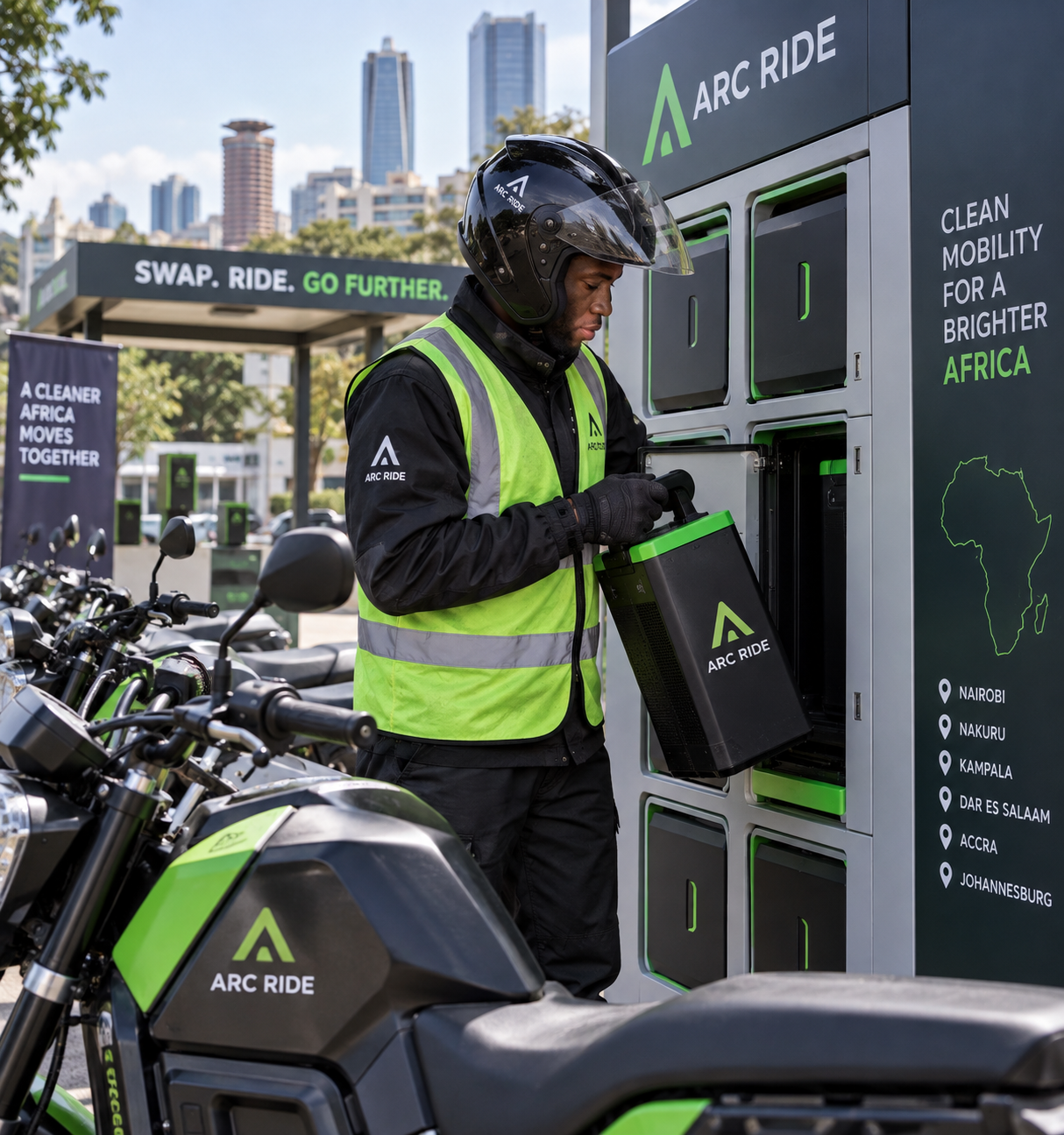
ARC Ride operates a Battery-as-a-Service model that allows electric motorcycle users to exchange depleted batteries at dedicated swapping stations instead of waiting for a battery to recharge.
That distinction is important for commercial riders.
For a delivery rider or motorcycle taxi operator, time spent waiting for a battery to charge can mean lost income. Battery swapping is designed to reduce that downtime while also removing some of the upfront cost of purchasing and maintaining a large battery.
ARC Ride currently operates automated battery-swapping cabinets across Nairobi and Nakuru, alongside battery laboratories and maintenance facilities. IFC’s assessment of the company describes battery management, charging and swapping as core parts of its operating model.
The funding will take ARC Ride beyond Kenya
ARC Ride plans to use the new financing to expand its infrastructure in Kenya and enter or scale operations in South Africa, Uganda, Tanzania and Ghana. Proparco says the investment will support the deployment of 5,000 electric motorcycles and charging infrastructure.
The company is therefore moving from being primarily a Kenyan electric-mobility operator toward building infrastructure that can serve multiple African markets.
That could prove more important than the number of motorcycles ARC Ride eventually puts on the road.
The real strategic opportunity is the network.
If battery-swapping stations become sufficiently widespread, electric motorcycles can become easier for commercial riders to operate without depending entirely on conventional charging infrastructure.
Africa’s motorcycle economy creates a large opportunity
Two- and three-wheelers already play a major role in transportation, delivery and informal commerce across many African cities.
That makes motorcycles one of the more practical entry points for electrification.
Kenya is already showing strong momentum. Recent market data indicate that electric two-wheeler sales reached 32,144 units in the first seven months of 2026, representing 22.3% of motorcycle sales in the market.
Other African markets are also developing battery-swapping networks. Spiro, for example, has raised significant financing to expand its own swapping infrastructure across multiple African countries.
The emerging competition suggests that Africa’s electric-mobility transition may not simply be about selling electric vehicles.
It could increasingly become a competition to build the energy and infrastructure networks behind them.
The infrastructure challenge
The economics of electric mobility in Africa are closely connected to the continent’s energy systems.
Nigeria provides a good example. Reuters reported in August that the country’s weak electricity supply remains a major obstacle to electric-vehicle adoption, with battery-swapping networks emerging as one way of reducing dependence on conventional charging infrastructure.
That makes battery swapping particularly interesting in African markets.
Instead of waiting for electricity grids and public charging networks to reach the scale required for mass EV adoption, companies can build dedicated infrastructure around high-use commercial vehicles.
But scaling that model will require significant capital.
Battery inventory, swap stations, software, maintenance facilities and energy infrastructure all have to expand alongside the vehicle fleet.
That helps explain the unusual structure of ARC Ride’s latest financing: venture capital provides growth capital while debt is being used to finance infrastructure and physical assets.
The Bigger Race Is Infrastructure
ARC Ride’s latest financing is therefore about more than another African startup raising money.
It reflects a broader shift in the continent’s electric-mobility market.
The next phase may be determined by which companies can build reliable networks of batteries, swap stations, vehicles, software and energy infrastructure at sufficient scale.
For ARC Ride, the immediate test is whether it can reproduce its Kenyan operating model across several very different African markets.
If it succeeds, the company could become less of an electric-motorcycle manufacturer and more of an infrastructure platform for Africa’s electric two-wheeler economy.
That is the part of this story worth watching.
Sources: ARC Ride financing information from ICON Corporate Finance and Proparco; IFC project documentation.